
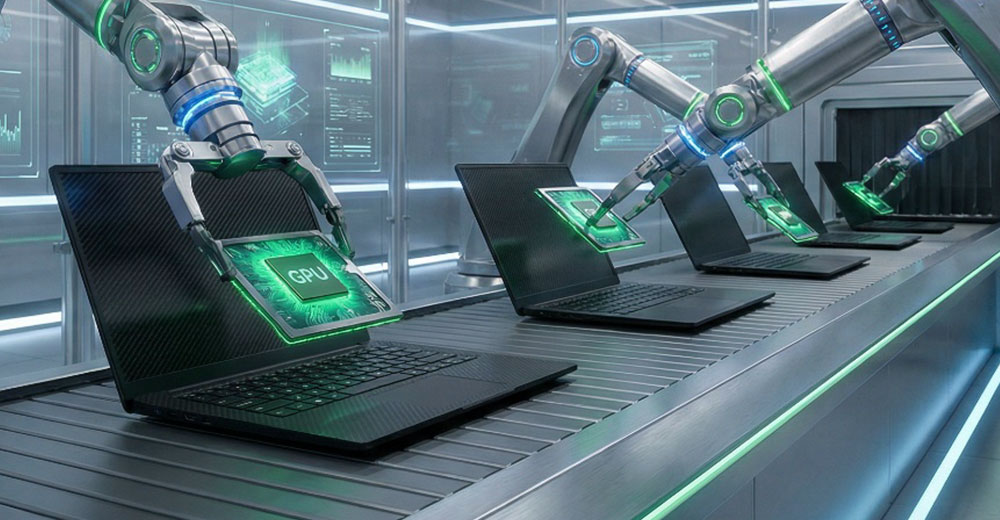
If Nvidia moves beyond GPUs to control more of the PC stack, tighter integration between chips, systems, and software could change how next-generation systems are built. (AI-generated image)
Every few decades, the tech industry shifts so dramatically that the landscape becomes unrecognizable. We saw it when IBM lost control of the PC to Microsoft and Intel, and again when the smartphone rendered the desktop an afterthought for the masses.
Today, we are standing on the precipice of another such shift. The rumor mill is churning with reports that Nvidia, the undisputed king of the AI era, is looking to acquire a major PC company.
While some dismiss this as mere speculation, if you look at Jensen Huang’s trajectory, it isn’t just plausible — it’s logical. Nvidia is tired of being a component supplier in a world where the “experience” is controlled by others. But as history shows us, moving from silicon to systems is a path littered with the corpses of ambitious giants.
Let’s talk about Nvidia’s rumored acquisition, and we’ll close with my Product of the Week, the closest thing to a PC that Nvidia now sells, the Nvidia DGX Spark.
Motivation: Beyond the Component Box
Why would Nvidia, a company with margins that are the envy of the world, want to get into the low-margin, high-headache world of PC manufacturing? The answer lies in the “full stack.”
In the AI generation, the bottleneck isn’t just the GPU; it’s the bus, the memory, the cooling, and the OS integration.
Nvidia’s Grace Blackwell architecture proves the company wants to own the entire data center rack. It follows that it would want to own the entire desk.
By acquiring a PC OEM, Nvidia could bypass the slow design cycles of traditional partners. It could then launch AI PCs built from the ground up to use NVLink, proprietary cooling solutions, and specialized AI software stacks that Windows — in its current form — struggles to optimize.
Potential Targets: Dell, HP, or a Wild Card?
If Nvidia pulls the trigger, who do they buy? To make this move worth the regulatory scrutiny, they need scale and a premium brand. Here are a few:
Dell Technologies is the most logical fit. Michael Dell and Jensen Huang already share a bromance rooted in AI infrastructure. Dell has the enterprise reach and the logistics engine that Nvidia lacks.
HP Inc. offers a massive footprint in the consumer and educational sectors, but its culture might clash with Nvidia’s high-performance, engineering-first ethos.
Razer or Asus are wildcards. If Nvidia wants to maintain its cool factor and focus on the high-end enthusiast market without the baggage of corporate PC fleet management, a smaller, premium brand might be the safer bet.
Lessons From 3D Vision and Shield
To understand Nvidia’s future, we must look at its past attempts to own the consumer experience. They haven’t always hit home runs. Remember Nvidia 3D Vision? It was a technically superior solution for 3D gaming that failed because it required an expensive, cumbersome ecosystem of monitors and glasses. It taught Nvidia that technical superiority doesn’t matter if the barrier to entry is too high.
Then there is the Shield TV. While a niche product, it is arguably the best Android TV box ever made. It showed that Nvidia could build hardware, support it for a decade, and create a loyal following.
However, a set-top box is a toy compared to the complexity of the global PC supply chain. If Nvidia approaches the PC market with the “closed” mindset of 3D Vision, it will fail. If it approaches it with the “premium utility” mindset of Shield, it has a fighting chance.
Acquisition History: Mellanox vs. Arm
Nvidia’s track record with acquisitions is mixed. The Mellanox acquisition was a masterstroke. It integrated high-speed networking into their data center play, creating a moat that Intel and AMD are still trying to bridge. It was a back-end success.
However, the attempted Arm acquisition was a regulatory nightmare that ended in a humiliating retreat. Buying a PC company like Dell or HP would trigger similar antitrust alarms. Regulators would argue that an Nvidia-owned Dell would have an unfair advantage in accessing the latest GPUs, potentially starving competitors like Lenovo or HP of the silicon they need to survive.
WinTel Vulnerability
For more than 30 years, the Windows-Intel (WinTel) duopoly was untouchable. But today, the armor is starting to crack. Intel is struggling with fabrication leads, and Microsoft is increasingly platform-agnostic, pivoting toward Azure and web-based services.
More importantly, the move toward Arm-based computing (Apple’s M-series) has proven that consumers value efficiency and integrated AI over legacy x86 compatibility. An Nvidia PC wouldn’t just be another Windows box — it would likely be an Arm-based powerhouse running a highly optimized version of Windows or even a specialized Nvidia Linux distribution for creators, leveraging Nvidia’s CUDA ecosystem in ways a generic PC cannot.
Path to Success: What Nvidia Must Do
If Jensen Huang wants to succeed where others have failed, he cannot simply put an Nvidia sticker on a Dell chassis. To win, Nvidia must:
- Solve the Power Problem: High-end Nvidia GPUs are power-hungry. A successful Nvidia laptop needs to replicate Apple’s performance-per-watt using Arm cores.
- Embrace the Ecosystem: They must ensure that their proprietary features don’t alienate the software developers who still build for the lowest common denominator of hardware.
- Maintain Partner Relations: This is the hardest part. The moment Nvidia buys a PC company, it becomes a competitor to its best customers. They would need to firewall their chip business from their PC business, a feat rarely achieved in this industry.
Probability of Success
Is it likely? No. Is it possible? With Jensen Huang, everything is on the table. He has a habit of betting the company on seemingly crazy ideas that become industry standards three years later.
However, the PC market is a low-margin grind. Nvidia currently enjoys 70% gross margins. A PC company would drag that down into the 20s. Wall Street might hate it, even if the technology is revolutionary.
Wrapping Up
The rumor of Nvidia buying a PC company is more than just corporate gossip; it signals that the era of the generic computer is ending. Nvidia has the cash, the silicon, and the AI software to build a vertical stack that could rival Apple in the Windows space.
However, the ghosts of 3D Vision and the scars of the failed Arm deal suggest that Nvidia’s greatest challenge won’t be engineering — it will be the industry’s politics and the sheer gravity of low-margin hardware. It wouldn’t just be buying a company — it would be declaring war on the way PCs have been built for forty years. It’s a high-stakes gamble that only a company with Nvidia’s current momentum would dare to take.